Not long after posting my video I found this:
Wednesday, April 21, 2010

Mickey and Me
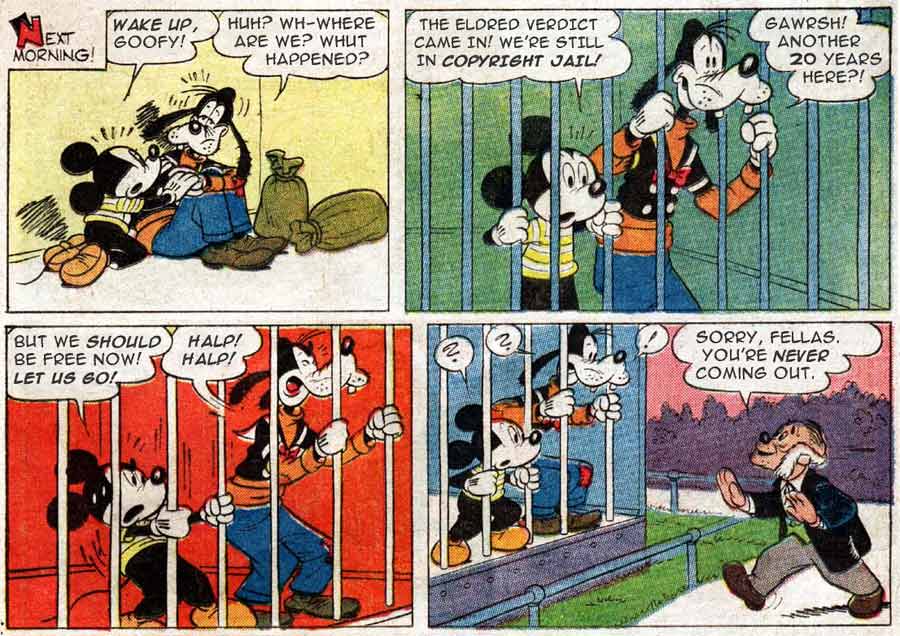
In order to better understand the project I've made I'm posting this link as a reference. No other company is as notorious as Disney for bringing legal action against those who copyright their material. The linked documentary is one that was made about Jed Horovitz and his legal battle against the company. Also, I found an extensive article discussing the prosecution of the Air Pirates, a group of cartoonists that made alternative comics featuring the beloved mouse in questionable situations.
Mickey and Me free download
Monday, April 19, 2010
Piracy or Policy?
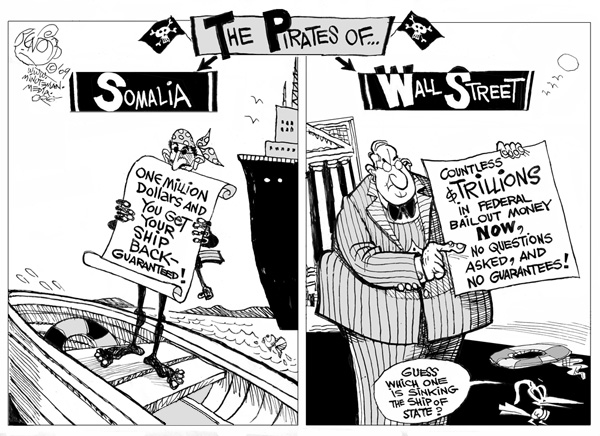
I found this great comic strip comparing the pirates of Somalia to the "pirates of Wall Street." I would have just left the post with the image but the blog post in which I found it was very interesting. The author asks (or at least quotes) the question:
"If piracy is a crime when individuals do it, what is it when states do it? Who can deny that America was stolen and swindled from the Indians? Or that millions of people were stolen from Africa to work for them for centuries? Is that piracy-- or just plain policy?"
A comparison that could be applied to the corporations that fight against media piracy don't you think? You can read the whole post (it's not very long) here at The Black Hour.


Sunday, April 18, 2010
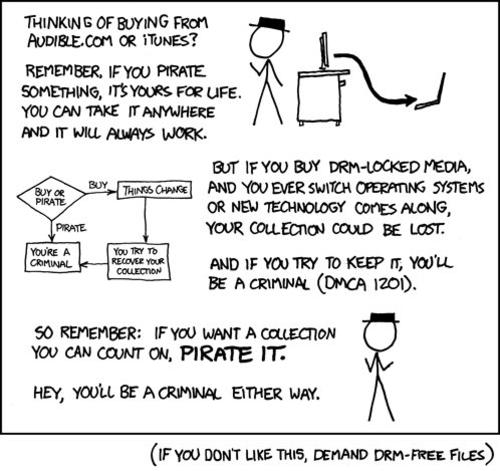
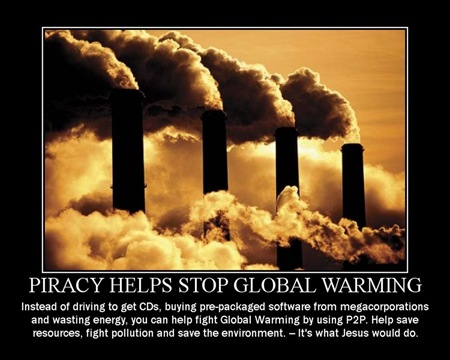
Wednesday, April 14, 2010
Comedy P.O.V.
In Dean's Step By Step to Stand Up Comedy, he talks about the comedian embodying three differing points of view. There is:
1) Narrator POV- how you perceive things as a nonparticipant or observer
2) Self POV- how you perceive things as a participant
3) Character POV- how you perceive things as someone or something else
In a stand up routine (which is what we are using as an example for our own philosophical routine) the three different POVs play out like so:
Observation comedians operate exclusively from NPOV; character oriented comedians submerge themselves in a vast array of CPOVs. Most comics employ some form of all three of the basic POVs.
While our aim is not specifically to make people laugh, somehow to me that just seems unavoidable. I think people should laugh when they're learning about philosophy....kind of like how I laugh in Greg Ulmer's class while learning about philosophy. You can use comedy to turn something difficult or hard into something hilarious...kind of like Dave Chappelle's experience in the ghetto.
1) Narrator POV- how you perceive things as a nonparticipant or observer
2) Self POV- how you perceive things as a participant
3) Character POV- how you perceive things as someone or something else
In a stand up routine (which is what we are using as an example for our own philosophical routine) the three different POVs play out like so:
NPOV [Narrator POV]: the comedian is never directly involved in the experience the joke is about, but observes, reports, talks about, or … narrates it.
CPOV [Character POV]: anyone or anything the comedian can act out as a character. This includes people, impersonations, animals, objects, and concepts such as emotions.
Observation comedians operate exclusively from NPOV; character oriented comedians submerge themselves in a vast array of CPOVs. Most comics employ some form of all three of the basic POVs.
While our aim is not specifically to make people laugh, somehow to me that just seems unavoidable. I think people should laugh when they're learning about philosophy....kind of like how I laugh in Greg Ulmer's class while learning about philosophy. You can use comedy to turn something difficult or hard into something hilarious...kind of like Dave Chappelle's experience in the ghetto.
Monday, April 12, 2010
Jokes About Somali Pirates pt. 2
I just came across this video as I was perusing the google video results for somali pirates. The anchor says some "interesting" things. I like the interruption by the tech guy as a kind of revealing punchline (thinking about the joke in terms of both Virno and Dean).
In our discussions in class about fallacy and taking advantage of the assumptions that people make about a particular topic (in our case the public policy topic we choose), we found that this is where we can slip in the joke, the Unthought, our conceptual persona's stance on the matter - kind of like Dean's expectation/surprise model of the joke.
So the real gem for me in this video is....what would it be like to be hijacked by a personable pirate?
In our discussions in class about fallacy and taking advantage of the assumptions that people make about a particular topic (in our case the public policy topic we choose), we found that this is where we can slip in the joke, the Unthought, our conceptual persona's stance on the matter - kind of like Dean's expectation/surprise model of the joke.
So the real gem for me in this video is....what would it be like to be hijacked by a personable pirate?
Jokes About Somali Pirates
So I've been thinking about the direction I'm going to be taking this blog in and I'm thinking about appropriating both footage/news/discussion about the piracy situation in Somalia, and or working with pirates in terms of Captain Jack Sparrow. Here's a video of comedian Joe DeVito already bringing those two together...in a joke! Even the description of the video is funny in using "pirate speak" (another strategy I've been thinking about using).

A screenshot of the description of the video. Click to enlarge.
Friday, April 9, 2010
Fallacy
"[...] if it is true that jokes are the diagram of innovative action, we will have to suppose that their logical form, or fallacy, plays an important role, since it has to do with changing the very mode of living." - (Virno p74)
A fallacy, in logic, is a failure in reasoning that renders an argument invalid - faulty reasoning; misleading or unsound argument. For our project we can utilize the structure of the fallacy to discover/enact/insert the Unthought into our public policy topic. The idea is to use the absurdity of the fallacy to counter the assumptions connected to our public policy topic. Below are some links to a few fallacies that I've been thinking about using.
Masked Man fallacy - perhaps I'm thinking of this wrong, but I think switching out the "man" referenced can also work for the fallacy.
Appeal to Poverty or Wealth - since all of this is an economic issue.
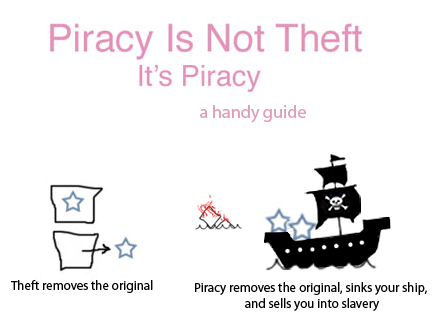
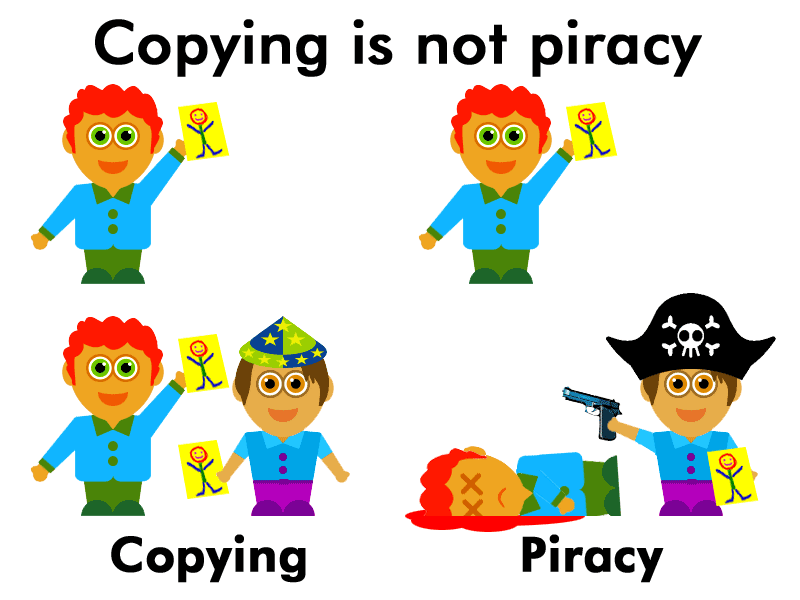
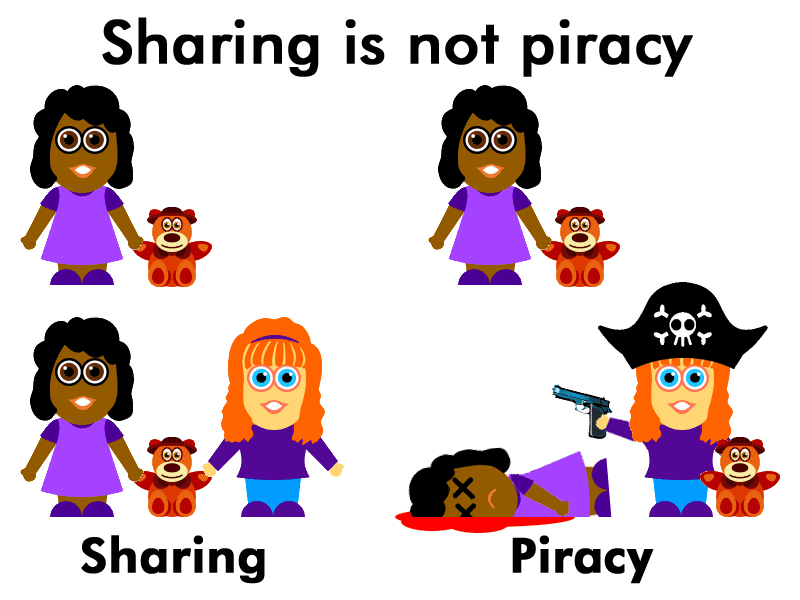
I liked this image because of its wordplay and use of humor in contrasting an assumption about piracy. While I'm not entirely sure if this would fit in the category of a fallacy of Arbitrary Redefinition, I feel like it could be of use to me.
Below is another quote I found in Multitude that struck me. I feel this best exemplifies how (or perhaps where) the joke/fallacy is situated in our project - a space where it can become a thought that subverts the established norms.
"it is nothing less than a political discourse held in a general assembly that urges towards insurrection against the constituent powers." - (Virno p82)
Thursday, April 8, 2010
Timing Is Everything
Virno's use of the theories of phronesis and kairos (from Aristotle's Nicomachean Ethics) in relation to the joke can be linked to what we have discussed about knowing what appropriation to use and when to use it. Just like any good joke ... timing is everything!
Phronesis is described as "practical know-how" (Virno p87) - part of that phronesis is knowing what's out there to appropriate.
Below is an excerpt from the my band's presentation on Appropriation:
Detournement is a key feature of appropriation, not necessarily because of what it does, but the importance of the philosophy behind it. Debord and Wolman don't feel that detournement in itself is important as a theory, but because it is connected with many key ideas and constructions of what they call the "pre-situationist transition" it therefore should be practiced and enriched (p39). Debord and Wolman are positioning the world in terms of pre- and post-situationist movement, but what we take from this is that the subjects used in detournement are constantly refreshing themselves and take on new meanings whether we appropriate them or not; it is in reading the subjects correctly that detournement can make the most impact. Being able to catch a subject at the right time and in the right situation, as well as interpreting it properly, is what makes detournement work.
In our case we must consider our audience (the electrate person who is internet savvy), and consider the techniques/privileges that our medium allows.
In the examples of phronesis and kairos we can develop an intertext between Virno, Dean, and the Appropriation readings - one that outlines for us a way to understand how the joke as innovative action can be connected to our acts of appropriation as innovative action.
Phronesis is described as "practical know-how" (Virno p87) - part of that phronesis is knowing what's out there to appropriate.
"Succeeding the painter, the plagiarist no longer bears within him passions, humours, feelings, impressions, but rather this immense encyclopedia from which he draws." (Sherrie Levine p81 - Appropriation)Kairos, or the perception of it, is the proper moment for performing an action. This of course would be the timing of the delivery of a joke, or knowing when to appropriate.
Below is an excerpt from the my band's presentation on Appropriation:
Detournement is a key feature of appropriation, not necessarily because of what it does, but the importance of the philosophy behind it. Debord and Wolman don't feel that detournement in itself is important as a theory, but because it is connected with many key ideas and constructions of what they call the "pre-situationist transition" it therefore should be practiced and enriched (p39). Debord and Wolman are positioning the world in terms of pre- and post-situationist movement, but what we take from this is that the subjects used in detournement are constantly refreshing themselves and take on new meanings whether we appropriate them or not; it is in reading the subjects correctly that detournement can make the most impact. Being able to catch a subject at the right time and in the right situation, as well as interpreting it properly, is what makes detournement work.
"Detournement's dependence "on memory implies that one must determine one's public before devising a detournement [...] The idea of pure absolute expression is dead." (Debord & Wolman - p35)
In our case we must consider our audience (the electrate person who is internet savvy), and consider the techniques/privileges that our medium allows.
In the examples of phronesis and kairos we can develop an intertext between Virno, Dean, and the Appropriation readings - one that outlines for us a way to understand how the joke as innovative action can be connected to our acts of appropriation as innovative action.
Wednesday, April 7, 2010
Using Appropriation
Lucy Soutter - Appropriation p166
This is interesting in the sense that appropriation (or at least the recycling of images, video, text, etc.) is the natural language of the internet. Or, to put it another way, the medium of the internet is conducive to appropriation as a form of language for communication. Our goal is to use appropriation to think philosophy through the medium of the internet. We also want to introduce the Unthought to our public policy topic. So...
If appropriation, the readymade, detournement, postproduction, etc. are all the same thing, then we can combine the lessons of each (from the articles in Appropriation) into our own set of instructions - in the case of my band, the 4 Laws of Detournement, simplified here:
- the more distant the association the more greater the impression.
- keep it simple stupid - the recontextualization will do all the work.
- the more the appropriation seems like an rational answer the less effective it is.
- simply positing the opposite is lazy and the least effective way of using detournement.
Since we are working towards adapting philosophy for the internet, we must keep this goal in mind at all times and try to have our appropriations serve this purpose (although shooting into the dark isn't a bad thing either)

"Appropriation has become not passe but so ubiquituous as to be beyond notice...appropriation has become the dominant trend in contemporary art practice, and that appropriated material no longer need signify anything in particular: not the death of the author, not a critique of mass-media representation, not a comment on consumer capitalism. On the contrary, it seems that appropriation is a tool of the new subjectivism, with the artist's choice of pre-existing images or references representing a bid for authenticity (my record collection, my childhood snaps, my favourite supermodel)"
This is interesting in the sense that appropriation (or at least the recycling of images, video, text, etc.) is the natural language of the internet. Or, to put it another way, the medium of the internet is conducive to appropriation as a form of language for communication. Our goal is to use appropriation to think philosophy through the medium of the internet. We also want to introduce the Unthought to our public policy topic. So...
If appropriation, the readymade, detournement, postproduction, etc. are all the same thing, then we can combine the lessons of each (from the articles in Appropriation) into our own set of instructions - in the case of my band, the 4 Laws of Detournement, simplified here:
- the more distant the association the more greater the impression.
- keep it simple stupid - the recontextualization will do all the work.
- the more the appropriation seems like an rational answer the less effective it is.
- simply positing the opposite is lazy and the least effective way of using detournement.
Since we are working towards adapting philosophy for the internet, we must keep this goal in mind at all times and try to have our appropriations serve this purpose (although shooting into the dark isn't a bad thing either)

Piracy As A Means For Production
The title of my blog has become a bit strange to me. in the beginning I was particularly interested in musicians such as Girl Talk or Super Mash Bros. As much as I love the music the blog moved elsewhere, focusing on the public policy issue surrounding piracy and became specifically geared towards people who pirate movies, music, software, etc.
And so I began to ask myself, "where's the 'production' in all of this?" Just because there are people out there downloading media this doesn't mean they are necessarily making anything with the pirated material...but It also doesn't mean that they aren't. How does piracy "take" and "remake" something? The artists exampled from the book on appropriation were producing things. This blog is an example of piracy as a means for production. Some of the images/videos on this blog weren't necessarily obtained legally. However, I reserve artistic freedom and interpretation. I'm doing this to further understand the issue.

But what about all those, like me before this class, who just simply pirate? Are they creating anything new? Is it out of laziness that they download illegal material? Is it some kind of revolutionary act against the economic structures of media business? I ask myself these questions because over the course of the semester I've come to the conclusion that neither side is correct.

Ulmer had some great advice about the clichés in my public policy topic. Both sides claim that the "art" cannot exist as long as the other continues to exist (there can be no music/movies if people continue to pirate; there can be no art if companies continue to copyright everything). Both statements are extreme and, in my opinion, aren't necessarily valid.
In the end I think it really comes down to purpose/intent...and here is where my stance gets a little complicated. Do we allow piracy only if it is with the intent to produce something? Doesn't this place more value on a product-based way of thinking? If a person downloads an album, shares it with their friend, who shares it with another friend (and so on) - are they not producing something? I always seem to get wishy washy when it comes to controversial issues. I'm not entirely sure that this one will get completely resolved for me - I don't think that I'll ever stop pirating music/movies/software, but then again that doesn't mean that I won't support those "products" that I admire or enjoy. For now I'll live by the philosophy that was once told to me by a professor:
And so I began to ask myself, "where's the 'production' in all of this?" Just because there are people out there downloading media this doesn't mean they are necessarily making anything with the pirated material...but It also doesn't mean that they aren't. How does piracy "take" and "remake" something? The artists exampled from the book on appropriation were producing things. This blog is an example of piracy as a means for production. Some of the images/videos on this blog weren't necessarily obtained legally. However, I reserve artistic freedom and interpretation. I'm doing this to further understand the issue.
But what about all those, like me before this class, who just simply pirate? Are they creating anything new? Is it out of laziness that they download illegal material? Is it some kind of revolutionary act against the economic structures of media business? I ask myself these questions because over the course of the semester I've come to the conclusion that neither side is correct.
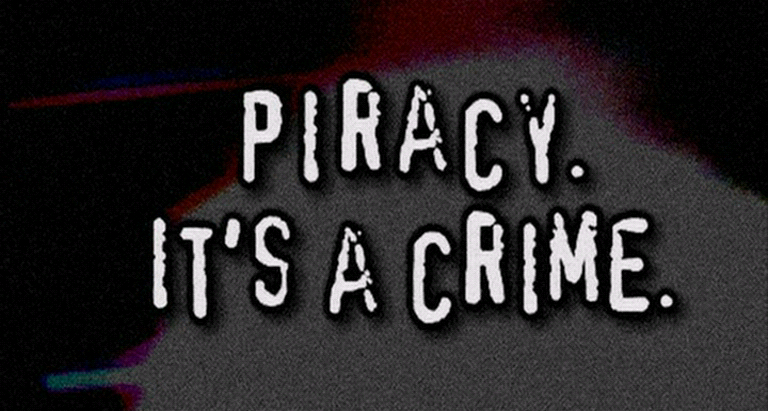
Ulmer had some great advice about the clichés in my public policy topic. Both sides claim that the "art" cannot exist as long as the other continues to exist (there can be no music/movies if people continue to pirate; there can be no art if companies continue to copyright everything). Both statements are extreme and, in my opinion, aren't necessarily valid.
In the end I think it really comes down to purpose/intent...and here is where my stance gets a little complicated. Do we allow piracy only if it is with the intent to produce something? Doesn't this place more value on a product-based way of thinking? If a person downloads an album, shares it with their friend, who shares it with another friend (and so on) - are they not producing something? I always seem to get wishy washy when it comes to controversial issues. I'm not entirely sure that this one will get completely resolved for me - I don't think that I'll ever stop pirating music/movies/software, but then again that doesn't mean that I won't support those "products" that I admire or enjoy. For now I'll live by the philosophy that was once told to me by a professor:
"I'll buy it [software] once I start making money from using it."
Tuesday, April 6, 2010

4 Laws of Detournement
For my second "Band" presentation, my group had to put together a set of instructions on how to use appropriation in our project of creating the Unthought (both for our public policy topic and for thinking philosophy through the medium of the internet). Much of what we based our instructions on (in fact, probably all of it) was taken from Guy Debord and Gil J. Wolman's Directions for the Use of Detournement - 1956. Listed below are their laws. Special thanks to Michele Nordie who helped with the presentation.
While we only had to read an excerpt from the complete article, I found a website with the whole text available to read here. Also, if you'd like, you can learn a bit about detournement from the comic strip Blondie - an interesting example of appropriation.

1. The most distant detournement elements contribute most sharply to the overall impression, and not the elements that directly determine the nature of this impression.
2. Distortions in the detourned elements must be as simplified as possible, since the main force of a detournement is directly related to the conscious or vague recollection of the original contexts of the elements.
3. Detournement is less effective the more it approaches a rational reply.
4. Detournement by simple reversal is always the most direct and least effective
While we only had to read an excerpt from the complete article, I found a website with the whole text available to read here. Also, if you'd like, you can learn a bit about detournement from the comic strip Blondie - an interesting example of appropriation.

What is Appropriation?

What is appropriation? That is what we try to discover from this text, edited by David Evans and published by the MIT Press. A collection of interviews and essays about the subject, the book covers the topic art historically, pointing out the various forms in which appropriation was used to make critical art.
Simply put, appropriation is the act of borrowing material (images, text, sound, etc.), usually without permission, for the purpose of creating something different than the original source material. We study appropriation as part of our Analogy, the method in which we tell our Tale. In relation to Virno's innovative action, appropriation can be an innovative act when it works towards recontextualizing or highlighting a problem in order to generate the Unthought.

Fountain - Marcel Duchamp

24 Hour Psycho - Douglas Gordon
Duchamp questioned the art object with Fountain (the readymade)... Douglas Gordon made us look closer at cinema with 24 Hour Psycho (a work from the postproduction section of the book).
The Joke As Innovative Action

In order for us to introduce the Unthought to our public policy topic and to our project of thinking philosophy through the medium of the internet we must devise a strategy for doing so. One of the texts in the second part of our class, Multitude: Between Innovation and Negation, describes how we as humans, with the gift of verbal speech, have the ability to modify our "forms of life, of diverging from established rules and customs" (Virno p69). Virno tells us that the joke is the diagram of innovative action, the kind of action needed in order to change the state of equilibrium. In order for us to disrupt normatives (we can think of this as introducing the Unthought) we must take innovative action. According to Virno, the joke is the best way:
"[...] jokes can offer us an adequate empirical basis for understanding the way in which linguistic animals give evidence of an unexpected deviation from their normal praxis."(Virno p72)
"if it is true that jokes are the diagram of innovative action, we will have to suppose that their logical form, or fallacy, plays an important role, since it has to do with changing the very mode of living."(Virno p73)
So...through the joke (or at the very least, it's linguistic structures - our joke doesn't necessarily have to elicit laughter) we can generate the innovative act, the Unthought, or perhaps even (in order to lead into the next quote) a creative gesture.
"human creativity is actually subnormative: it manifests itself uniquely, that is, in the lateral inappropriate paths that happen to open themselves to us just as we are forcing ourselves to conform to a determined norm."(Virno p73)
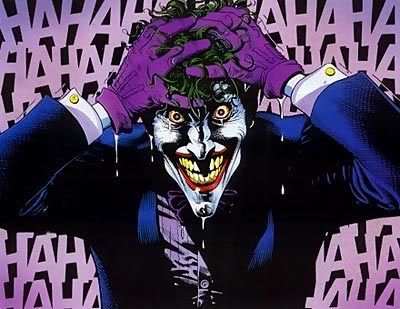
So then, could we possibly understand The Joker as the most creative/innovative villain of all time?
Subscribe to:
Posts (Atom)